Understanding Diastasis Recti: What Every Postpartum Woman Should Know
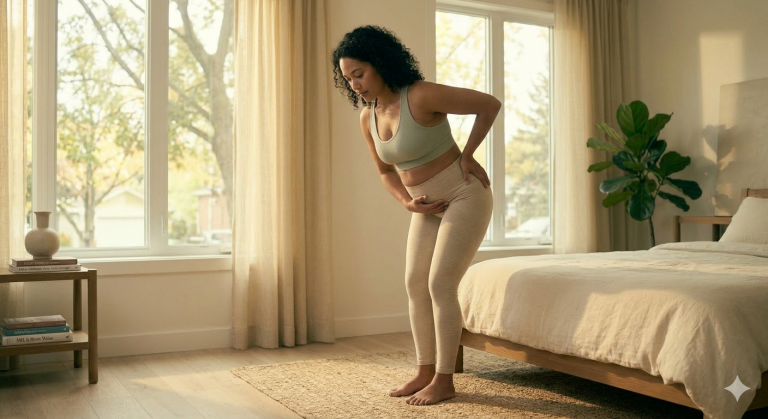
Diastasis recti—or “abdominal separation”—is one of the most common postpartum concerns we address at Nuvo Physio. If you’ve noticed a gap down the center of your belly after pregnancy, a bulging sensation when you cough or sneeze, or lower back pain that won’t quit, you’re not alone. This condition affects up to 60% of postpartum women, yet many don’t realize it’s treatable with targeted physiotherapy.
The term “diastasis recti” literally means “separation of the rectus abdominis muscles”—the straight abdominal muscles that run vertically down your belly. During pregnancy, hormonal changes (particularly relaxin) soften connective tissue, and your growing baby naturally stretches these muscles apart. This is completely normal and necessary. The goal of recovery isn’t about “closing the gap”—it’s about restoring function, strength, and confidence in your core.
Many women feel shame or frustration about their postpartum belly. We want you to know this is a normal physiological response to pregnancy, and with proper guidance, you can regain strength, reduce back pain, and return to activities you love.
Why Diastasis Recti Happens: The Physiology of Pregnancy
Your abdominal wall is an intricate system of muscles, connective tissue (fascia), and nerves working together to support your spine, organs, and breathing. During pregnancy, this system undergoes dramatic changes:
Hormonal Changes: The hormone relaxin, released throughout pregnancy and continuing for months postpartum, increases flexibility in connective tissues by up to 150%. This is essential for childbirth but means your core muscles lose some of their natural “tension” and supportive capacity.
Physical Stretching: Your growing baby displaces your abdominal muscles laterally (outward) and inferiorly (downward). The linea alba—the connective tissue running down the center between your rectus abdominis muscles—thins and stretches significantly.
Postural Changes: Your shifting center of gravity during pregnancy changes how you move, stand, and sit, putting additional stress on core muscles already working overtime.
Increased Intra-Abdominal Pressure: Pregnancy increases pressure inside your abdomen, pushing outward on weakened tissues. This continues postpartum, especially if breathing patterns haven’t normalized.
The important thing to understand: your body didn’t fail. It adapted beautifully to grow and birth a baby. Recovery requires time, intentional movement, and professional guidance—not punishment or extreme exercise.
Assessing Your Diastasis Recti: How Bad Is It?
Not all abdominal separation requires intensive rehabilitation. The severity of diastasis recti is measured by three factors:
Width of Separation: How far apart are your rectus abdominis muscles? This is measured in finger widths (approximately 1.5 cm per finger). Some separation after pregnancy is normal; significant diastasis typically involves a gap of 2-3 finger widths or more.
Depth of Separation: Are the muscles bulging outward when contracted? Depth indicates how much the linea alba (connective tissue) has stretched. A shallow gap with intact connective tissue requires different treatment than a deep, mushy separation.
Tension and Tone: Do your muscles feel soft and weak, or are they responding to engagement? Functional capacity matters more than gap size. A woman with a 2-finger gap but strong, coordinated core function often does better than someone with a 1-finger gap but poor muscle activation.
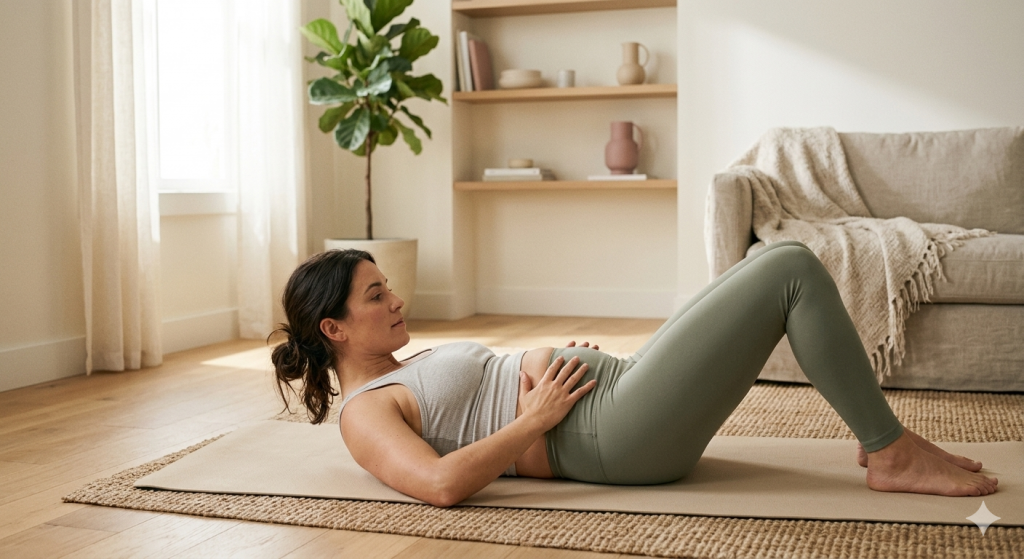
Self-Assessment Technique: Lie on your back with knees bent and feet flat. Place your fingers just above your belly button, pressing gently. Engage your core by tilting your pelvis slightly or doing a mini crunch. Feel whether your muscles engage under your fingers and whether there’s a gap between them.
This assessment gives you a baseline, but professional evaluation is essential. We recommend scheduling a physiotherapy assessment 6-8 weeks postpartum to rule out complications like pelvic floor dysfunction, which commonly co-occurs with diastasis recti.
The Connection Between Diastasis Recti and Pelvic Floor Health
One critical point we emphasize with every postpartum client: diastasis recti and pelvic floor dysfunction are deeply connected. Both conditions involve core muscles that work together as an integrated system.
Your pelvic floor muscles sit at the base of your core, your deep abdominal muscles wrap around your trunk, and your diaphragm (breathing muscle) sits at the top. When diastasis recti develops, it disrupts the coordination of all these muscles. This commonly leads to urinary incontinence, pelvic organ prolapse, and lower back pain.
Many women assume they just need “core exercises” to fix diastasis recti. But if pelvic floor dysfunction is present, traditional crunches and sit-ups can actually worsen symptoms. This is why we assess and treat the entire pelvic core system at Nuvo Physio, not just the abdominal muscles.
If you’re experiencing any of these alongside diastasis recti, professional assessment is especially important:
- Leaking urine when coughing, sneezing, or jumping
- Heaviness or bulging sensation in the vagina
- Pain with intercourse
- Constipation or straining with bowel movements
- Persistent lower back or pelvic pain
Evidence-Based Recovery: The Physiotherapy Approach
The best news about diastasis recti? With proper rehabilitation, most women see significant improvement within 8-12 weeks. Here’s the evidence-based approach we use at Nuvo Physio:
Phase 1: Breathing and Awareness (Weeks 1-4)
Before any exercise, we address how you’re breathing. Pregnancy and childbirth often disrupt breathing patterns, increasing intra-abdominal pressure and preventing proper core coordination.
Diaphragmatic Breathing: This foundational technique teaches your body to breathe fully and coordinate with your pelvic floor. Lie on your back with a pillow under your knees. Place one hand on your chest and one on your belly. Inhale slowly through your nose, feeling your belly rise (not your chest). Exhale fully, feeling your belly fall. This simple practice restores breathing patterns and reduces pressure on your healing core.
Pelvic Floor Awareness: Begin noticing and gently engaging your pelvic floor muscles as you exhale. This isn’t about squeezing hard—it’s about light, coordinated engagement. Many postpartum women have overactive or disconnected pelvic floor muscles that need gentle re-education.
Posture Awareness: During this phase, you’ll relearn how to stand and sit without increasing abdominal pressure. Many postpartum women thrust their hips forward or arch their lower back excessively, putting stress on recovering tissues.
Phase 2: Gentle Core Activation (Weeks 4-8)
Once breathing and pelvic floor awareness are established, we progress to gentle muscle activation exercises:
Supine Transverse Engagement: Lying on your back with knees bent, engage your deepest abdominal muscles (transverse abdominis) on exhalation. Imagine drawing your belly button toward your spine—gently, not forcefully. Hold for 3-5 seconds, then relax. This activates your core without increasing pressure or creating a bulge.
Glute Engagement: Your glute muscles are part of your posterior core chain. Lying on your back or side, engage your glutes on exhalation, hold, then release. This distributes work away from your struggling abdominal muscles.
Bird Dogs (Modified): On hands and knees, engage your core, then extend one leg back while keeping your pelvis level. This teaches core stability and coordination without extreme loading.
Heel Slides: Lying on your back, slide one heel away from your body while maintaining core engagement and pelvic stability. This teaches your deep core to stabilize as your limbs move.
Throughout this phase, we watch carefully for doming or bulging of the abdominal wall. If your belly domes outward when you exercise, you’re creating too much pressure and the tissues aren’t ready for that load. We modify exercises until movement happens without bulging.
Phase 3: Progressive Loading (Weeks 8-16)
As your core demonstrates the ability to stay engaged without bulging, we gradually increase demands:
Quadruped Exercises: Planks (modified, short duration), quadruped hip extension, and quadruped shoulder taps teach your core to stabilize your entire body.
Standing Exercises: Marching in place, standing glute engagement, and light resistance exercises (using bands or light weights) integrate your core with functional movement.
Dynamic Breathing with Movement: Coordinating breathing with larger movements—bending, reaching, stepping—restores normal breathing patterns during activity.
Functional Activities: We progress toward activities that matter to you—carrying your baby, playing with your child, returning to sport or exercise—always monitoring for bulging or discomfort.
Phase 4: Return to Activity (16+ weeks)
By this phase, most women are ready to return to activities they love. We progressively load your core with:
- Running or higher-impact exercise
- Intense fitness classes
- Sport-specific movements
- Heavy lifting or resistance training
The key is gradual progression and monitoring. Returning too quickly causes setbacks; progressing gradually builds lasting strength and confidence.
The Exercises We Recommend: Your Home Program
If you’ve been assessed by a physiotherapist and cleared to begin home exercises, here’s a sample progression:
Breathing Foundation (Daily):
- 3 sets of 10 diaphragmatic breaths, twice daily
- Focus on full exhalation and gentle pelvic floor engagement
Core Activation (5x per week):
- Supine transverse engagement: 3 sets of 8 reps (5-second holds)
- Glute engagement: 3 sets of 10 reps
- Modified bird dogs: 3 sets of 8 reps each side
- Heel slides: 3 sets of 10 reps each leg
Progression (Week 6-8 onwards, if cleared):
- Quadruped holds (short duration, 10-20 seconds)
- Standing marching with core engagement
- Gentle planks (start with 15-20 second holds)
- Resistance band exercises (light resistance)
Important: These are general guidelines. Your specific program depends on your assessment, your pelvic floor function, and your postpartum timeline. Some women are ready to progress faster; others need to stay in earlier phases longer. This is why professional guidance is so valuable.
What NOT to Do: Common Mistakes That Slow Recovery
We see many women unintentionally delay their recovery by doing well-meaning but inappropriate exercises. Here’s what to avoid:
Traditional Crunches and Sit-ups: These create extreme pressure in your abdominal wall and can worsen diastasis recti. Avoid them until you have professional clearance (often 12+ weeks postpartum) and your core demonstrates functional strength.
Intense Planking Too Early: Long plank holds create substantial intra-abdominal pressure. Short, well-controlled holds are safer in early recovery.
Heavy Lifting Before Core Readiness: Carrying heavy groceries, picking up your older child, or lifting weights with inadequate core stability worsens separation and can create symptoms like back pain and heaviness.
Running Too Soon: High-impact exercise multiplies intra-abdominal pressure. Return to running gradually after demonstrating good core control during walking and lower-impact activities.
Excessive Abdominal Massage or “Splinting”: While some targeted soft tissue work can help, excessive massage or tightly binding your abdomen with corsets can inhibit natural muscle recruitment.
Ignoring Pelvic Floor Dysfunction: If you’re experiencing leaking, heaviness, or pain alongside diastasis recti, addressing only abdominal separation won’t resolve your symptoms.
When to Seek Professional Help
While many cases of diastasis recti resolve with appropriate home exercise and patience, certain situations warrant professional assessment at Nuvo Physio:
- Your diastasis recti isn’t improving after 12 weeks of consistent exercise
- You’re experiencing pain, heaviness, or bulging that interferes with daily activities
- You’ve returned to exercise and developed new symptoms (leaking, back pain, pelvic pressure)
- You have concurrent pelvic floor dysfunction
- You’re considering surgical repair and want to optimize your core first
- You’re beyond the typical postpartum timeline (6+ months postpartum) and still struggling
Professional physiotherapy assessment clarifies whether your diastasis recti is a simple functional gap or whether deeper issues like pelvic floor dysfunction or scar tissue involvement need attention.
Preparing for Return to Sport: Special Considerations
If you were active before pregnancy, returning to sport requires careful progression. Our approach at Nuvo Physio is to progress systematically through these phases:
Phase 1: Walking and Low-Impact Activity (Weeks 6-8)
- Walk for 20-30 minutes most days
- Monitor for heaviness, bulging, or leaking
- Maintain core awareness during walking
Phase 2: Intermediate Impact (Weeks 8-12)
- Elliptical or stationary cycling
- Swimming (excellent for core strength without high pressure)
- Gym-based resistance training with light loads
- Yoga with modifications
Phase 3: Sport-Specific Training (Weeks 12-16)
- Sport-specific drills at controlled intensity
- Dynamic movement patterns relevant to your sport
- Gradual increase in intensity and volume
Phase 4: Return to Competition (16+ weeks)
- Full participation in your sport
- Ongoing core maintenance as part of training
Read our full article on return to sport after pregnancy for sport-specific guidance.
Nutrition and Lifestyle Factors That Support Healing
Core recovery isn’t just about exercise. Several lifestyle factors accelerate healing:
Adequate Protein: Your healing tissues need amino acids. Aim for 1.2-1.6 grams of protein per kilogram of body weight daily. This is especially important if you’re breastfeeding.
Hydration: Proper hydration supports tissue healing and optimal muscle function. Aim for 2.5-3 liters of water daily, more if breastfeeding.
Sleep Quality: Your body rebuilds and repairs during sleep. Prioritize 7-9 hours per night, understanding that interrupted sleep is normal with a newborn. Do what you can.
Stress Management: Chronic stress elevates cortisol, which can slow tissue healing. Gentle activities like walking, meditation, or time outdoors help manage stress.
Avoid Smoking: Smoking significantly impairs tissue healing and should be avoided during recovery.
Manage Constipation: Straining with bowel movements increases abdominal pressure. Adequate hydration, fiber, and gentle movement help prevent constipation.
The Timeline: What to Expect
Understanding the realistic timeline helps manage expectations:
Weeks 1-4: Focus on breathing, awareness, and very gentle movement. Your body is still in acute recovery from pregnancy and birth.
Weeks 4-8: Gentle core activation exercises. You may notice improved posture and reduced back pain.
Weeks 8-12: Progressive strengthening. Many women see visible improvement in their abdominal contour and reduced bulging.
Weeks 12-16: Return to more demanding activities. Most women feel confident in their core stability.
Months 4-6: Significant functional improvement. Most cases of diastasis recti show substantial progress by 6 months postpartum.
6-12+ Months: Continued improvement is possible for years postpartum. It’s never “too late” to improve diastasis recti, even if you’re months or years past birth.
Individual timelines vary based on severity, overall fitness, adherence to exercise, and presence of other complications like pelvic floor dysfunction.
Frequently Asked Questions About Diastasis Recti Recovery
Will my gap ever fully close?
The gap may not fully close, and that’s okay. What matters is functional strength and the absence of symptoms. Many women with a 1-2 finger gap remaining have excellent core function and no limitations. A perfectly closed gap with weak muscles is less functional than a visible gap with strong coordination.
Can I do planks and push-ups again?
Yes, most women can return to planks and push-ups, but timing matters. We typically recommend waiting 12+ weeks postpartum and demonstrating good core control in less challenging exercises first. Full push-ups may take 4-6+ months depending on your starting point. Modified versions are great intermediate steps.
Is surgery necessary for diastasis recti?
Surgery is rarely necessary and isn’t recommended in the first year postpartum. Conservative physiotherapy resolves most cases within 6-12 months. If diastasis recti persists beyond 12-18 months and is significantly affecting your function or body image, you might explore surgical options, but always with physiotherapy optimization first.
Can I get diastasis recti again with a second pregnancy?
Yes, it’s more likely with subsequent pregnancies. However, maintaining good core strength between pregnancies and being intentional about your core during pregnancy (prenatal physiotherapy) reduces severity. Many women experience less separation with their second pregnancy if they’ve properly rehabilitated from their first.
Does breastfeeding affect diastasis recti recovery?
Breastfeeding itself doesn’t negatively affect recovery, but ensure you’re well-supported when feeding (good posture, nursing pillows) and eating enough calories and protein. Many breastfeeding women need an additional 500 calories daily, which supports tissue healing.
What if I have pain alongside my diastasis recti?
Pain isn’t normal and suggests something more complex is occurring—possibly pelvic floor dysfunction, scar tissue issues, or postpartum complications. Professional assessment is essential when pain accompanies diastasis recti. Read more about postpartum recovery complications in our comprehensive guide.
Recovery Is Possible: Your Path Forward
Diastasis recti is common, manageable, and responsive to appropriate treatment. Most women see significant improvement within 8-12 weeks of consistent, guided rehabilitation. The key is starting with a professional assessment, understanding that your core involves multiple interconnected systems, and committing to a progressive exercise program.
At Nuvo Physio, we’ve helped hundreds of Montreal women recover from diastasis recti and return to the activities they love. Whether you’re 6 weeks postpartum or 2 years past birth, your core has the potential to become stronger and more functional than before pregnancy.
Recovery starts with one step—often a conversation with a pelvic health physiotherapist who understands not just abdominal separation, but your entire pelvic core system and your goals.
Book a consultation at Nuvo Physio to assess your diastasis recti and develop your personalized recovery program. We’ll guide you through evidence-based rehabilitation and help you regain confidence in your postpartum body.